The problem
Small shops and developers who want to receive bank transfers automatically usually pick one notification service, integrate each provider separately, match money to orders themselves and deal with the same transaction being reported twice. S Pay puts that in one place: money still lands directly in the seller's bank account; S Pay only reads the credit notifications, matches them to orders and notifies the app.
The solution
- Many notification sources: GPMPay, ApiPay, SePay, Casso, payOS and direct bank webhooks (ACB, MB). Each source is authenticated its own way (signatures, API keys, HMAC); duplicates across sources are merged.
- Per-order QR + automatic matching: a VietQR with a unique memo for each order; when money arrives the order turns "Paid" and the app receives an HMAC-signed webhook (retried on failure).
- Receiving-account routing by channel (counter / online) — S Store uses it to keep counter and online money apart.
- For developers: API v2 with Deprecation headers, a sandbox, "Connect S Payment" OAuth for third-party apps, .NET / Go SDKs,
/llms.txtdocs and a "Copy prompt for AI" button.
Connection assistant — the browser station
Some partners have no API for creating keys; you have to sign in to their website and click through several steps. S Pay runs a browser station (Node + Playwright, one Chromium per session) and a Claude Haiku agent that follows a per-partner playbook:
- The user picks partners in the "Set up payments" popup; the bank comes first, then GPMPay / ApiPay run one after another.
- Passwords and OTPs are typed in the S Pay form; the station fills them into the partner page and never stores them. The partner's screen is only shown as a fallback.
- The agent only acts inside the dialog that is open and asks the user when unsure. Once a key is obtained, S Pay connects the source itself.
- Rule: one account per legal entity at each partner — no extra accounts to game free plans.
Chat assistant
A chat panel in the console answers from the workspace's own data: 12 read-only tools running under the asker's portal permissions, plus a connect-suggestion card when no source exists yet. Quotas: 25 questions + 300k tokens per workspace per day, 5 tool rounds, 45 seconds per answer. Users must consent to sending data to the model provider before chatting; workspace owners can turn the assistant off.
Open to the public
- Sign-up by email (HMAC-signed link, valid 60 minutes) or Google (PKCE, verified emails only); 2FA is mandatory.
- A Free plan with 50 matched transactions per month; versioned Terms and Privacy pages.
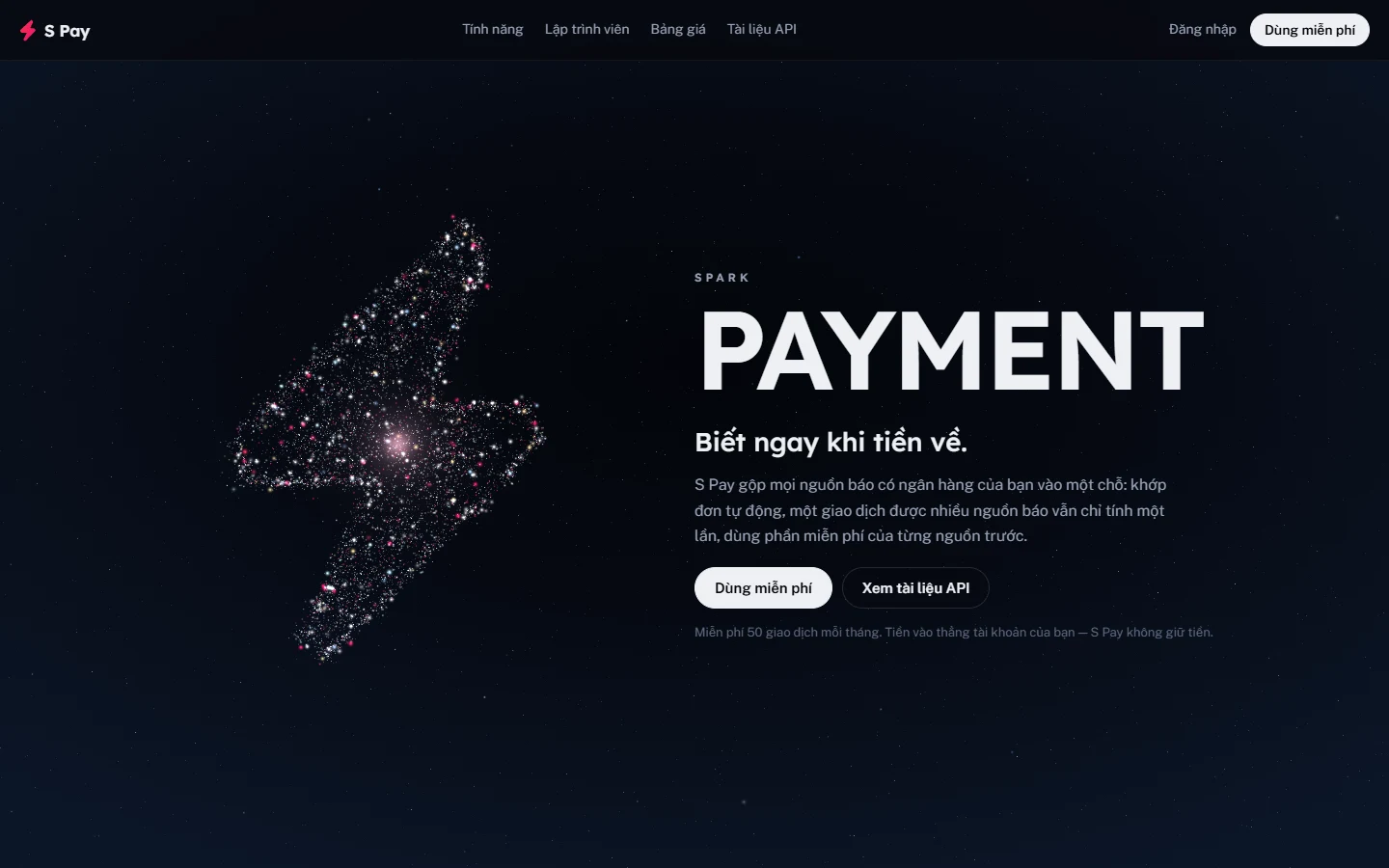
- A Three.js landing page: ~11,000 particles (4,200 on phones) converge into the lightning logo, with 9 scroll-driven scenes — sources, merging, QR, load sharing, assistant, API / webhooks, security, pricing, closing.
Technologies
| Technology | What it is used for |
|---|---|
| .NET 10 + EF Core + PostgreSQL | API, transaction matching, webhooks, incoming-funds reports; migrations run on start-up |
| Vue 3 + Naive UI + Pinia + Vite | Operations console and user portal (multi-page: portal + landing) |
| Three.js 0.160 | Landing page: two Points layers + shaders, precomputed layouts interpolated by scroll, loaded after first paint |
| Node 22 + Playwright | Browser station for the connection assistant, running separately in the cluster |
| Claude (via MotKey) | The agent driving the browser station and the chat assistant; dedicated virtual keys with daily / monthly spend caps |
| HMAC · OAuth 2.0 · TOTP | Signed webhooks and sign-up links; Google sign-in; 2FA |
| Kubernetes + ArgoCD | Deployed through a gitops repo — merging means production |
Results
Running for S Store (counter + online QR) and MotKey's VND credit wallet. Open to everyone since 18 Nov 2026; the assisted GPMPay connection flow has run end to end with a real bank account.
Highlights
Credit notifications from many sources: GPMPay, ApiPay, SePay, Casso, payOS and direct ACB / MB bank webhooks; each source is authenticated its own way, and duplicates across sources are merged.
Per-order VietQR, automatic money ↔ order matching, HMAC-signed webhooks with retries; API v2 + sandbox + .NET / Go SDKs; /llms.txt docs and a "Copy prompt for AI" button for coding assistants.
Connection assistant: a Playwright browser station opens the partner site, the user types password / OTP inside the S Pay form (never stored), an agent fills in the rest and connects the source; a "Set up payments" popup runs partners one after another.
In-console chat assistant: 12 read-only tools under the user's own permissions, per-workspace question / token quotas, explicit consent before data is sent, and owners can turn it off.
Open to the public: email sign-up (HMAC-signed link) or Google (PKCE), mandatory 2FA, Terms / Privacy pages; a 9-scene Three.js landing page — stardust converges into the logo and the story unfolds as you scroll.